

Fashion Ecommerce | Mobile App | AI Experience | Concept Project
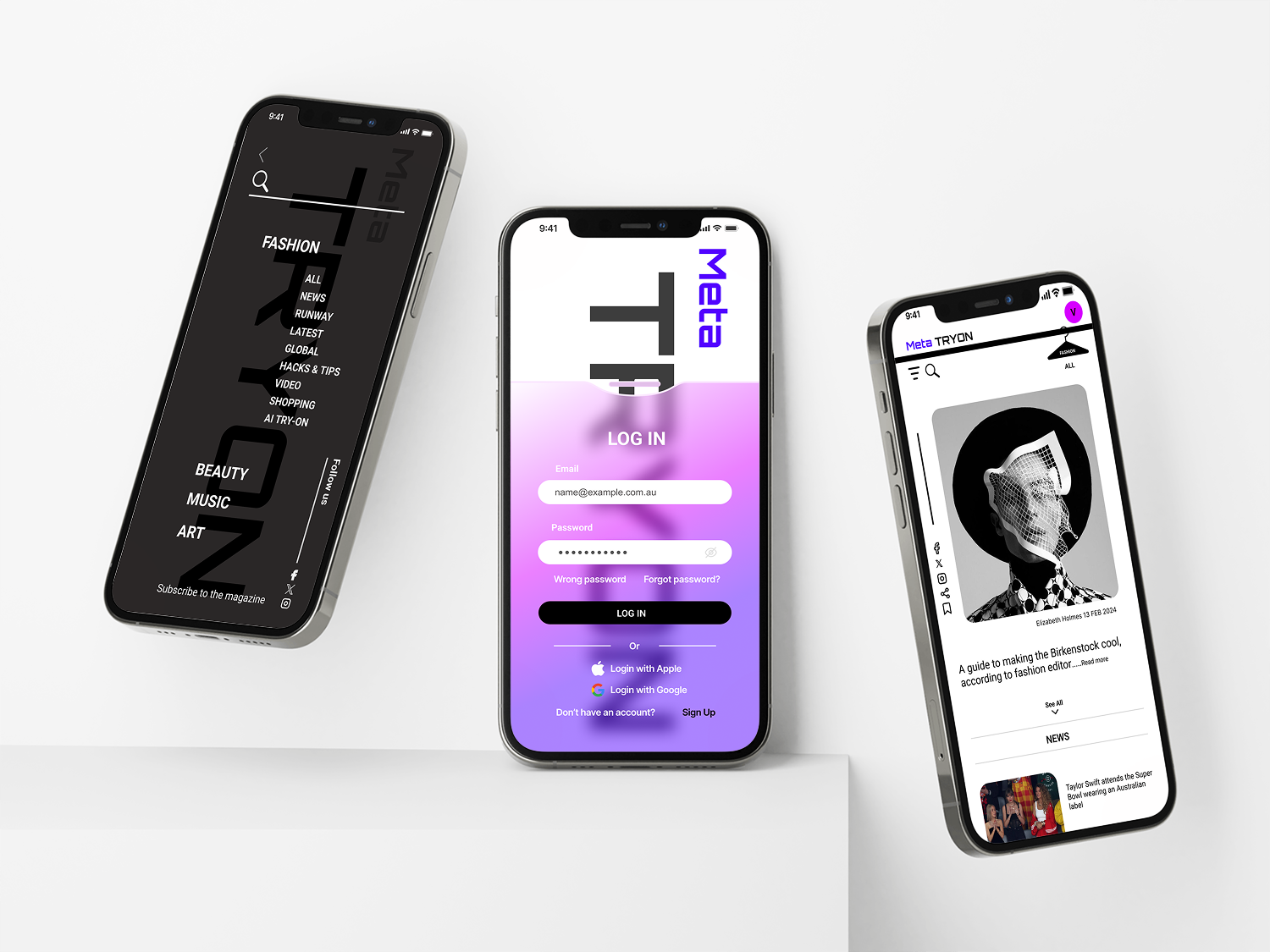
Meta TRYON
An AI fitting room that lives in your pocket! so you actually know something will fit before you buy it, not after it shows up.
View All Work

OVERVIEW
RESEARCH
SOLUTION
RESULTS
Project Overview
A concept project built around one question:
what if you didn't have to physically try something on to know it'd fit?
ROLE
UX/UI Designer
DURATION
8 Weeks
INDUSTRY
Fashion E-commerce
PLATFORM
Mobile App
User Journey
Usability Testing
Wireframes
User Research
Competitive Analysis
Design System
Prototype
User Persona
The Challenge
You can't tell if something will actually fit until it's already at your door, so you order two sizes, keep one, and send the rest back.
30 to 40%
of online fashion orders are returned, most often for fit and sizing reasons.
62%
of shoppers say uncertainty about fit is their biggest hesitation before checkout.
$ 7B+
lost annually by fashion retailers to return logistics and restocking.
3.5x
higher return rate for apparel compared to other ecommerce categories.
Figures reflect widely reported fashion-ecommerce return benchmarks, used here as directional context for this concept project.
"Will it fit me?"
Help people find the right fit, shop with actual confidence, and stop second-guessing every "add to bag."
The Goal
-
Know your recommended size before you buy, reducing hesitation at checkout.
-
Receive personalised size recommendations based on your unique body measurements.
-
Understand why a size is recommended with transparent fit insights.
-
Get recommendations tailored to your body shape, preferences, and past selections.
-
Make more informed purchasing decisions and reduce size related returns.
Research
I talked to 14 people who shop online constantly, picked apart five competitor apps, and looked for where the pattern actually broke down.
“I buy three sizes of the same top just to be safe. Two always go back.”
Sophie Williams | Student | Female |Age 20’S
Pain point. Inconsistent sizing between brands erodes trust before purchase.:
“Product photos never show how it looks on a body shaped like mine.”
Emma Chen | Marketing Manager | Female |Age 30’
Pain point. Lack of representative visuals lowers purchase confidence.
“Return shipping fees make a "cheap" order expensive fast.”
Rachel Nguyen | Primary School Teacher | Female |Age 40’S
Pain point. Hidden cost of returns discourages trying new brands.
“I don't have time to try things on and repackage returns.”
Mia Thompson | HR Advisor | Female |Age 30’S
Pain point. Return friction outweighs convenience of shopping online.
Competitive Analysis
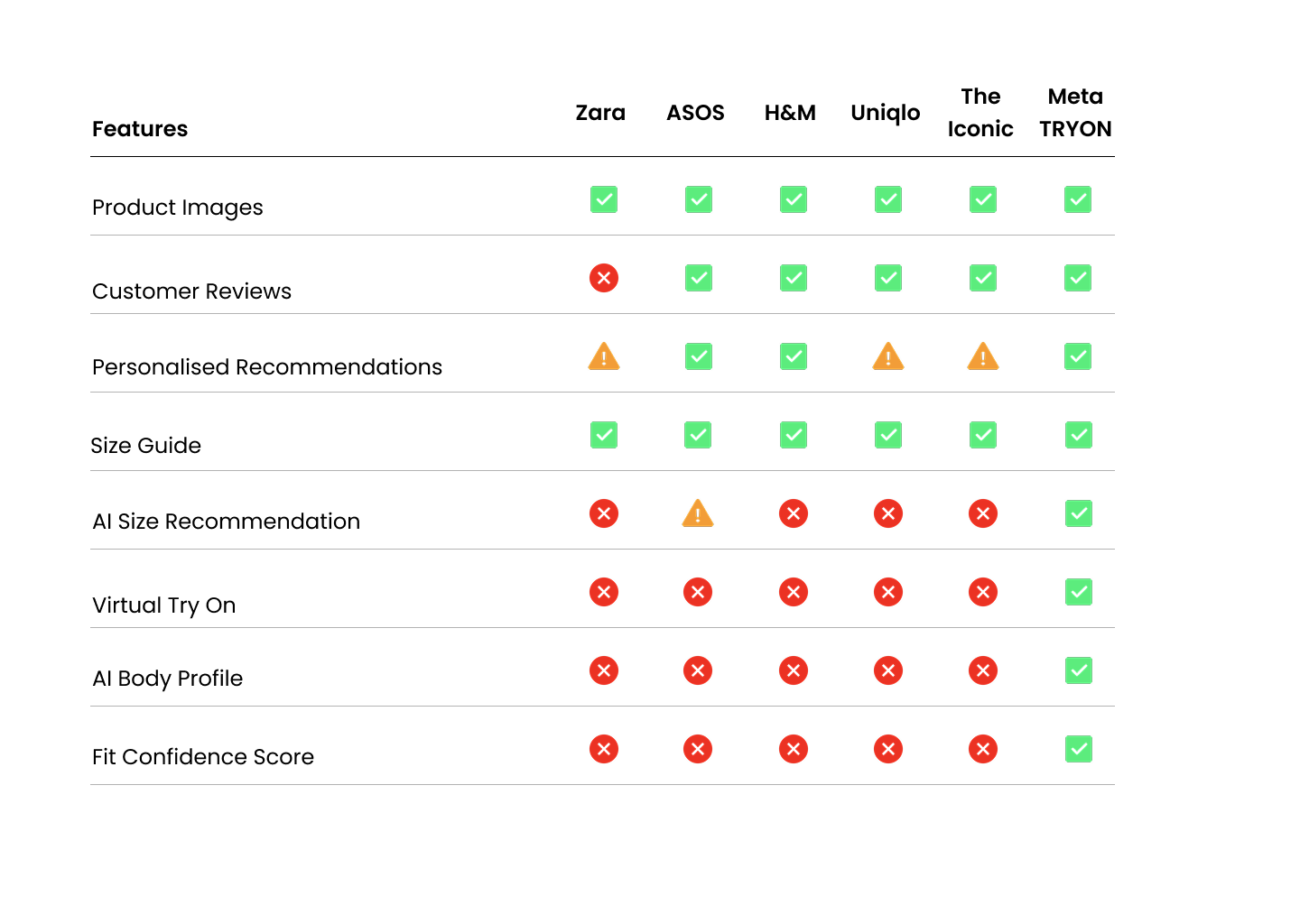
Every one of these does product photography and reviews well. Not one of them actually helps you figure out if the thing will fit you.
That's the gap Meta TRYON is built to close.
Design Opportunities
Four things I kept coming back to whenever a design decision got hard.
01_Personalise the fitting experience
Your actual body, not a generic size chart. Build it once, reuse it everywhere.
02_Reduce size uncertainty, visibly not just accurately
A number you're not allowed to question isn't reassuring. It's just doubt wearing a percentage sign.
03_Increase purchase confidence
Tell people why, not just what size to pick. The reasoning is what actually builds trust.
04_Simplify decision making
If the AI adds a decision instead of removing one, it's not actually helping.
User Journey
Eight steps from opening the app to checkout. Confidence needed to build the whole way, not just show up once at the end.
Welcome
A short, honest explanation of how the AI body scan works and how the data is used.
01
AI Body Scan
A guided 30-second scan using the phone camera to capture shape and proportion.
02
Review Measurements
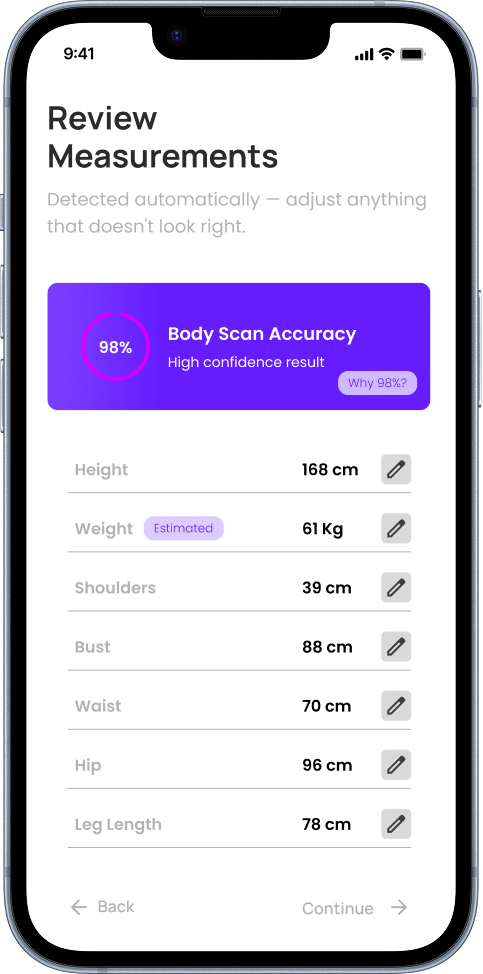
The one manual checkpoint in the whole app, the shopper verifies and edits the scan, backed by a visible accuracy score, before it quietly powers every recommendation from here on.
03
Generate Avatar
A private digital avatar is built from the profile, ready to wear any garment in the catalogue.
04
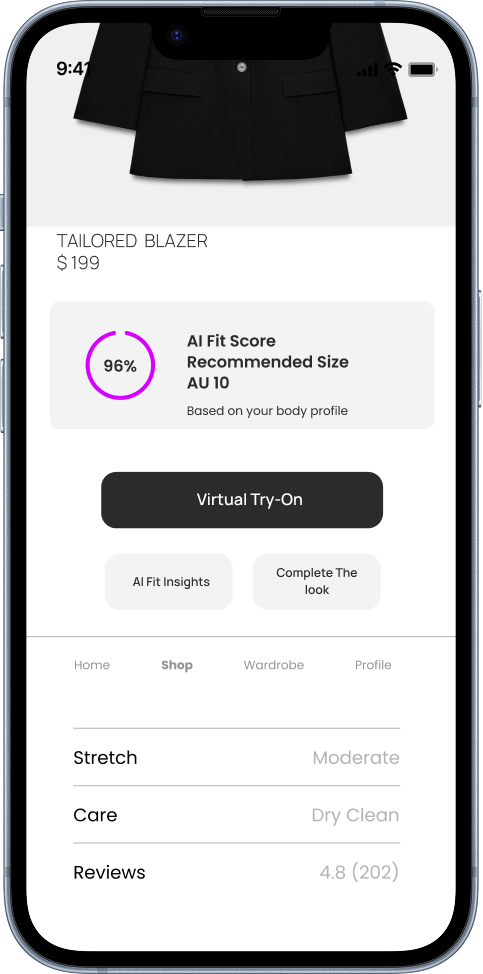
Every product card already shows a personal fit score, before it's even opened.
05
Browse
Virtual Try-On
The garment renders on the avatar in the selected colour and size in real time.
06
AI Size Recommendation
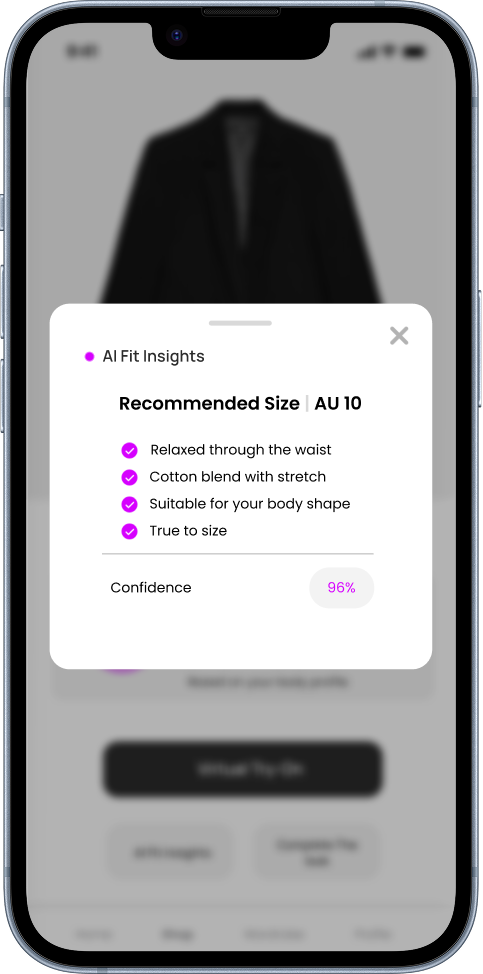
One recommended size, with a plain-language reason behind the suggestion.
07
Checkout
The fit confidence score travels with the item all the way to purchase.
08
Solution
Six features, one confident checkout
One AI body profile, reused for everything: try-on, sizing, styling, the whole trip through the app.
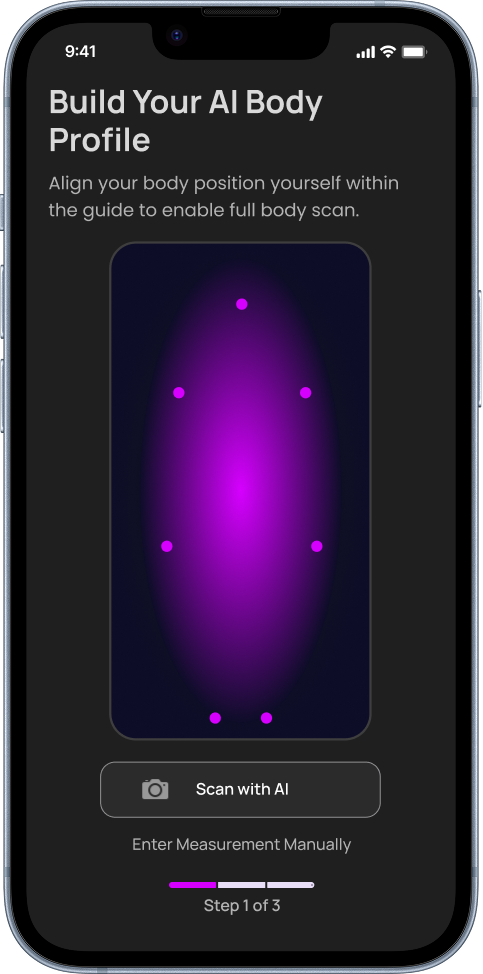
AI Body Profile
Create a personalised body profile using guided measurements.
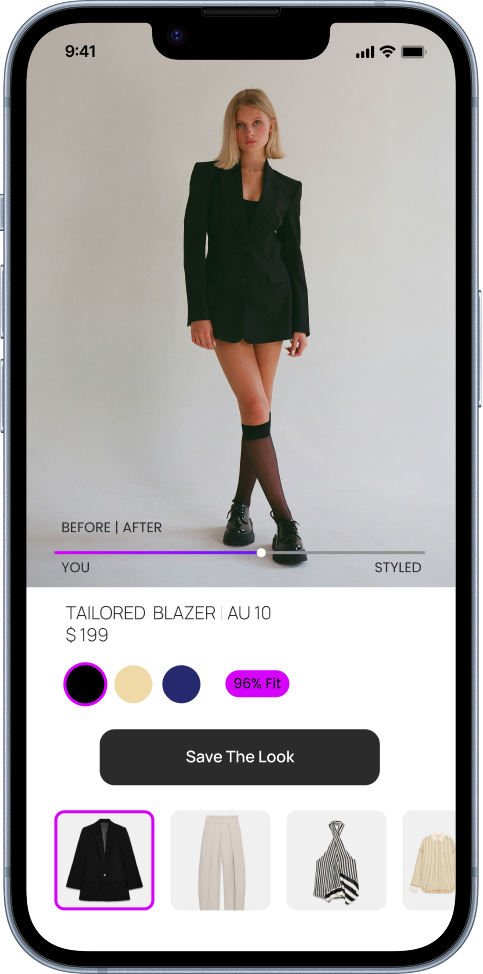
AI Virtual Try-On
Preview garments on a personalised avatar before purchasing.
Review Measurements
The best size, based on body measurements and brand-specific sizing.
Fit Confidence Score
Clear guidance such as True to Size, Relaxed Fit or Slim Fit before checkout.
AI Fit Insights
Explain scan accuracy and let users adjust measurements before confirming their recommended size.
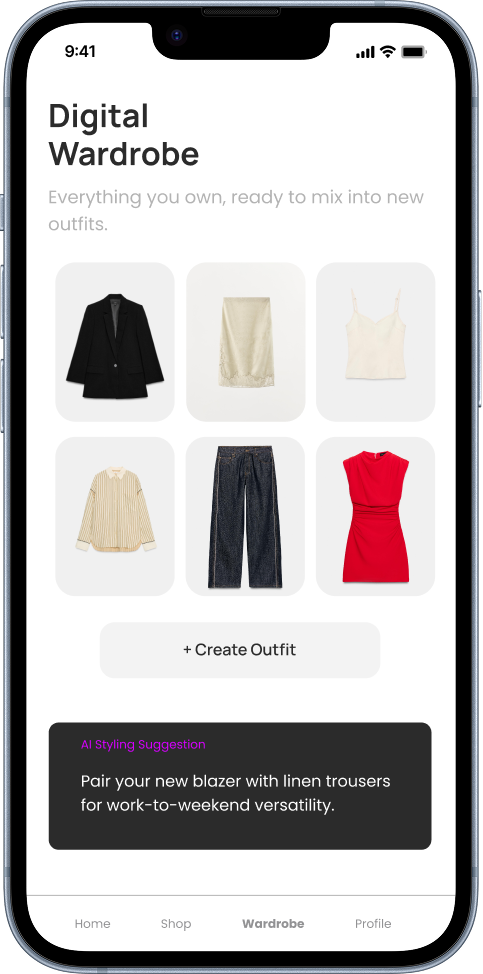
Digital Wardrobe
Save past purchases to improve future recommendations and styling.
Feature Spotlight
The idea began with a magazine page, seeing an outfit styled on a model and imagining it on yourself.
This is that moment, rebuilt as a real interaction, any garment, rendered on your own AI avatar, before you buy.
Instant outfit switching
Move between saved items and "complete the look" pairings without leaving the screen.
Colour compare
Preview every available colourway on your own avatar, not a generic model.
Rotate view
See drape and fit from the angles a flat product photo can't show.
Before / after slider
Compare your everyday self against the styled result, side by side.
Key UX Decisions
Three spots where I couldn’t assume people would trust the AI. The interface had to earn it.
01
THE TENSION
An accuracy score means nothing if the shopper has no way to judge it. "98%" is either blind trust or blind doubt.
THE DECISION
Made the score inspectable. A "Why 98%?" control reveals the actual evidence: scan angles, landmarks tracked, calibration source. Any field with weaker visual signal is labelled estimated so the shopper knows exactly what to double check.
02
THE TENSION
AI scans won't always land right: bad lighting, a loose top, an awkward pose. If the only way forward is "Continue," a bad result quietly poisons every recommendation after it.
THE DECISION
Gave Retake Scan a permanent, quiet home on the Avatar Generated screen, not buried in settings. Recovering from a bad result needed to be as easy as getting one.
03
THE TENSION
A visible "Save Avatar" button implies the data might not be saved otherwise, an unnecessary decision layered onto a profile that's already the shopper's own.
THE DECISION
Autosave runs silently; the interface only confirms it happened. The rule that shaped this across the app: AI should remove effort, not add a step asking for permission to do its job.
Result
Value on both sides of the screen
For the customer
Increased confidence before purchasing
More accurate size selection
Faster purchasing decisions
Reduced hesitation at checkout
For the business
Higher conversion rate
Reduced product returns
Increased average order value
Stronger brand loyalty
Reflection
Meta TRYON started as a question I kept hearing on the shop floor, long before I designed anything
"will this actually fit me?"
Years working in the fashion industry gave me an instinct for where sizing breaks down between brands, between body shapes, and between a product photo and a real person. Bringing that experience into UX and AI meant designing a system that explains its recommendations, rather than simply making them.
The clearest example is the Review Measurements screen. At first glance, it is just a list of measurements with edit icons. In reality, it is where shoppers can understand why the AI is confident in its recommendation instead of being asked to trust it without explanation. Once I recognised that, three design decisions followed naturally: make the confidence score easy to understand, give users a clear way to correct inaccurate body scans, and avoid asking permission to save measurements that already belong to the shopper.
The biggest lesson was restraint: the AI needed to feel present but quiet, trustworthy by being checkable, rather than by being confident. That's a different design problem than making something look intelligent, and it's the one I'd spend the next iteration on.